
I heard about the opportunity to travel to Bangladesh at a storytelling workshop I attended. The purpose of the trip was to teach English to young students, who were studying translation at college. The facilitators of the program had some vacancies, and I’m the kind of the person to think ‘Why not? I’ll give it a go.’ I’d never done anything like that before, and they needed people, so why not? I didn’t have the money to pay for the trip myself, but fortunately the church I was attending paid for everything for me to go over. That was such a gift.
I had spent three years travelling around Australia in a motorhome and was weary of the sight of endless gum trees and beaches. I wanted to experience something different. The only international travel I had done was a Christmas cruise to New Zealand the previous year. Bangladesh was to be my first real overseas experience.
When the opportunity in Bangladesh came up, I’d only just come out of a ten-year relationship, and I needed to change direction in my life. Everything I was doing at the time was new, and the willingness to give it a go was coming from this place of newness. I was practically living on my own, and it was tough. I felt like I was throwing myself way out of my comfort zone, but that’s what I needed to do to get out of the rut I was in. To change direction, to swim upstream and do things differently.
I’d been in relationships for most of my adult life, and it was hard being out on my own. I was trying to re-educate myself so I could gain employment. At the time I was studying a diploma of community services, so I thought this opportunity in Bangladesh would fit in well with that.
I heard about the opportunity at Eastertime in April 2014, and we were to depart at the end of June. In the interim we met once a month with the other participants. The program was being headed up by a team of Bible translators, and I was going to be teaching some songs in English. There was an older fellow from my church named Bob; we were the only two coming from Brisbane, and we just happened to be in the same church group.
The week before our departure, the four of us went away for four days to Maleny in the Sunshine Coast Hinterland for an intensive preparation program. We wore the clothes we were going to wear and ate the food we would be eating in Bangladesh. We had to try and learn not to use water, so we did things like clean our teeth dry. All to try and get us used to what it would be like over there.

I lost my nephew to suicide a week before I left on my trip to Bangladesh. At the time I asked my family ‘What should I do? Should I go?’ I would miss the funeral if I did, but they wanted me to go, because they knew my nephew would have wanted it.
Despite my raw grief, on departure day I was feeling very excited. I wasn’t nervous at all. My brother dropped me at the airport, and I waited there for a while on my own until Bob arrived. It was the first time I had been in an international airport. We flew from Brisbane to Kuala Lumpur, and then onto Dhaka, the capital city of Bangladesh. Apart from one other older couple, we were the only westerners on that flight. Bob looked like a grandfather with his white hair. We stood out like sore thumbs!
We travelled all night and arrived in Dhaka in the early hours of the morning. The airport was so rundown, like nothing I’ve ever seen in Australia. I don’t really know how, but we got through customs okay. I’d heard some other people have had problems, but I think it helped being accompanied by an older man. Bob said all older people were respected in Bangladesh, so we just stuck together.
From customs we went straight to get our money exchanged. We had already been told exactly which window to go to; there were lots of people selling phones and exchanging money, but this particular guy had the best deals. We exchanged $100 Australian and came away with $1000s of Taka. It was quite surreal to be in possession of so much money!
It was mid-morning by the time we left the airport. It was crazy outside; there were all these people wanting to take you for a ride in their car. We didn’t know the language so didn’t know how to say where we were going, and the drivers didn’t speak any English at all. Fortunately, the leader of our translation program was there to meet us. He knew how to pick a driver, and could negotiate with them in Bengali. I don’t know how we would have got to where we needed to go had we not had him with us!
We jumped in this rickety old van, and I volunteered to sit in the front seat. There was a rail across the dashboard, and I hung on for the ride. It was so much fun! I’d wanted to dive right into the culture, and there I was, in the front seat of this tiny little van, as the driver was beeping the horn and changing lanes. There were six lanes of traffic in what should have been three. I loved it all the way!
Our accommodation was a western-style motel, with all the basic facilities we needed, including proper toilets. It was nice and civilised, probably the equivalent to a 2 star motel back home. After settling in we had dinner; there was no tea or coffee, although we did have a delicious sweet tea. Even in the quieter hours of the night you could still hear all the cars on the road outside. It was great; it was all happening right there around us. It was exciting being in a totally different culture, being in a developing country. Everyone was very friendly. Some more people were traveling from America to join us, and someone else was coming from South Australia, so we still had another day to wait for everyone to arrive.
The next day we travelled to where we would be running the translation program. Our transport was a van with darkened windows. The security risk for westerners wasn’t as bad back then as it is now, but there was still a risk. The village we were traveling to was only 20 kilometres outside Dhaka, but it took us hours to get there because we were only driving about 20 kilometres an hour. It was lovely to be able to get away from the busyness of the city. The roads were dirt and there were potholes everywhere. The translation college was being run out of a new conference centre being built by a local Bangladeshi man. This is where we would be staying for the next month. There were big walls around the compound. It was pretty safe there back in 2014, and we were okay to go out and walk around the village, as long as we went together. We met the local people, including the Imam of the village mosque, with whom we chatted and took a photo. Everyone gathered around us, and there were a few students from the college who wanted to practice their English with us.
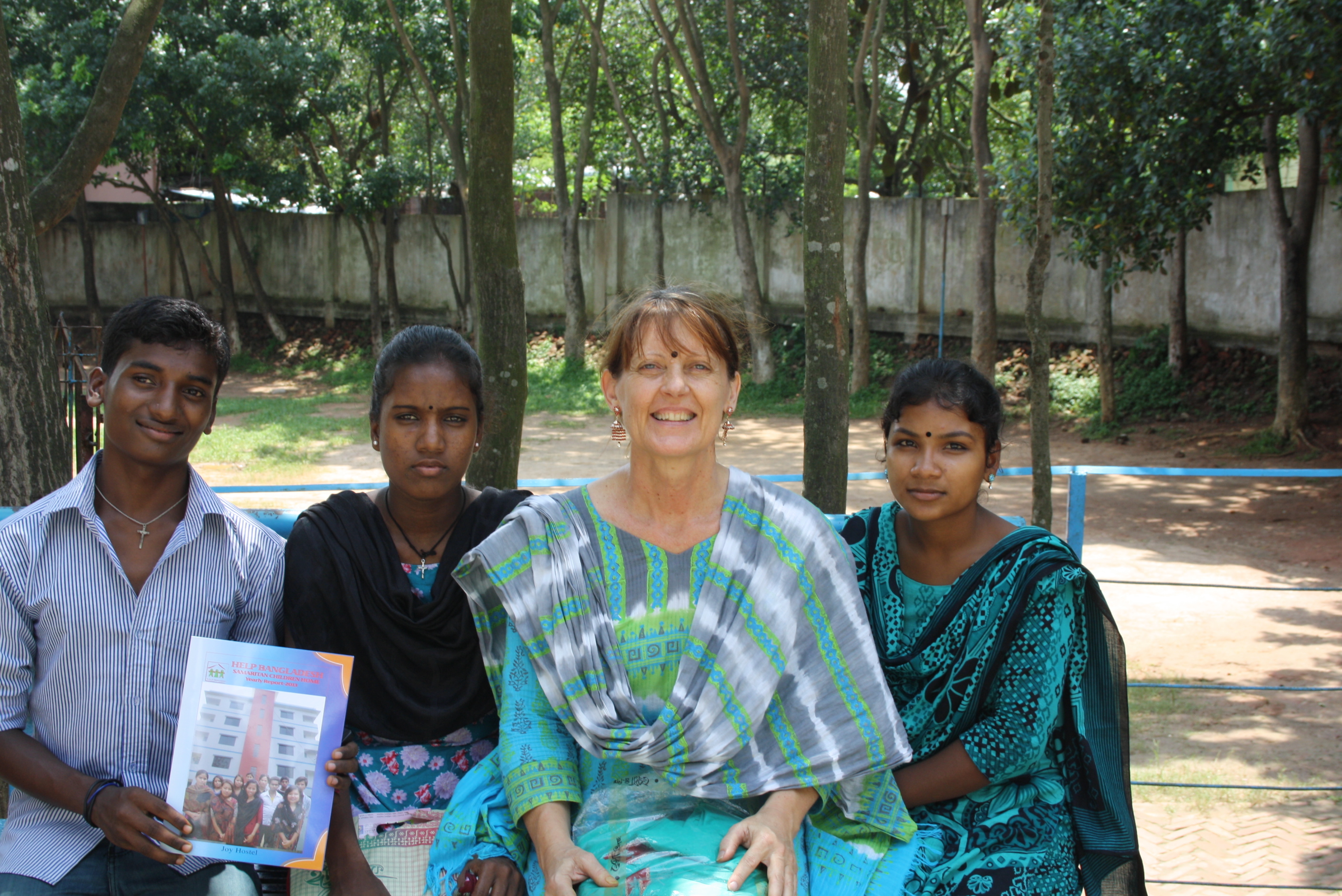
This was only the second time the facilitators had gone over to Bangladesh as part of the program, so it was still new even for them. No-one really knew what was going on, and we were just winging it! But there wasn’t much to plan; I had organised the songs I was going to teach the students, and I had learned them in what I thought was Bengali. But in the end my translation wasn’t even close, and the students ended up teaching me how to speak it properly!

It was summer in Bangladesh, and it was ridiculously hot all the time. Every day felt like the hottest day of a Queensland summer. There was no air-conditioning; we had fans but the whole place was run off a generator, which kept cutting in and out through the day. The fans were constantly going on and off, and we would break out in a sweat while we waited for them to come back on. I was very impressed with the cotton clothing; I was covered from head to toe, but the light fabric was cool to wear.
Every day we went out and walked around the village for an hour or so, buying some bananas and a bit of water. I loved it. One day we went on a tuk tuk ride, and the driver took us all around the place. It was great being able to be so immersed in the culture.
I received a text message from my brother just after the funeral telling me everything had gone well, and I just broke down. I cried and cried and cried. I couldn’t go out and have breakfast, and everyone was wondering what was wrong. It was at this point in the trip that I was also starting to feel quite sick. Our cook was very good, and he was used to cooking for Westerners, but the food mainly consisted of rice, and I was starting to feel weak. I lost 10 kg over the month in Bangladesh, but we didn’t have any mirrors there and I didn’t realise how much weight I’d lost until I got home to Australia.
I think the biggest lesson I learned from my trip to Bangladesh was the value of money. The Bangladeshi people have no money to waste, and once I arrived home, I found it difficult to waste even the smallest amounts. So now I always respect money when I have it.
The advice I would give anyone from the western world traveling to a developing country is don’t compare. Leave your life behind and just immerse yourself. Open up and accept the culture, because you’re not going to be there long. Just enjoy it and be open to the differences. Don’t judge them, don’t criticize them. Just accept it all and be respectful.
Another piece of advice I would give other women is to respect the culture. Learn a little bit about it and just respect it. Don’t try and take it on. The way we approach those situations sometimes is to do whatever we want. That might be okay in a western society, but you can put yourself in danger if you push your western values onto these cultures. I was lucky I had Bob to travel with, and I felt safe with him. I don’t think I would have enjoyed it anywhere near as much if I’d been on my own. I would have been in danger, in fact, because for a woman to be walking around on her own was just not the proper thing to do there.
It’s been five years since my trip, and traveling to Bangladesh is a different story now. They’re hardly letting Westerners into the country anymore. But now, the whole translation program is run by the locals. Our organisation came in and helped them for three years until the first group of students from the college finished their bachelor’s degree in translation. Now, the whole program is run by them.
There are places in Australia that I would like to revisit, but I would also like to see some different things. I’m interested in going over to Scotland and Wales, where my family heritage is. My daughter is planning on moving to Ireland for a year, so I’d like to go over and see Ireland with her while she’s there. I’m not really interested in just going and seeing and ticking off a whole heap of places just for the sake of it. I love the experience of living somewhere and immersing in their culture. That’s what I’d like to do when I go overseas again: just go to one place, spend some time there and experience it that way.
Discover more from Kate Kelsen
Subscribe to get the latest posts sent to your email.

