
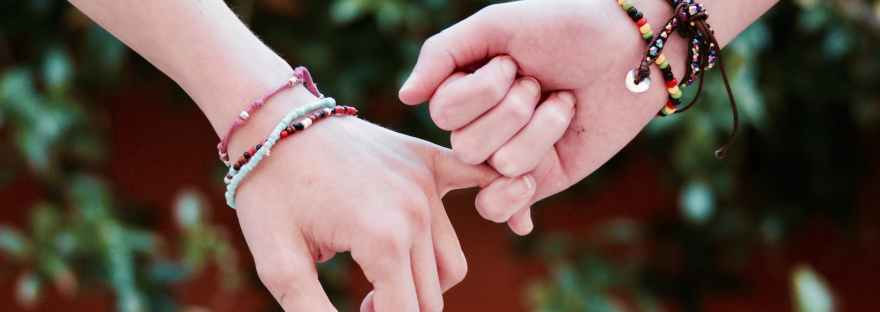
The importance of values, standards, and boundaries in friendships.
In this post, I reflect on the tendency to overlook conflicts in friendships and emphasise the need for open communication and accountability. I share personal experiences of losing and nurturing friendships, highlighting the impact of genuine connections and mutual respect. I encourage addressing concerns and holding space for difficult conversations in friendships to strengthen bonds. The message underscores the significance of vulnerability, honesty, and willingness to put in the work for meaningful and authentic friendships.
When we talk about having values in relationships, we will likely think of the romantic kind. There is an abundance of information on the subject, in the form of books, TED Talks, podcasts and articles. But what about having values in our friendships?
As adults, I don’t think we talk about fallouts with friends enough. To me it feels like an adolescent conversation, one we have as teenagers when we had an argument with our best friend at school. Not a conversation we expect to be having as adults.
There is information out there about how to deal with problems arising in adult friendships. I discovered this when I googled the topic last year, after some major fallouts. Which got me thinking about the idea of holding space for conflict in friendships the same way we are guided to do in romantic relationships. Of course we do it, I just feel like we don’t talk about it as much.
We know romantic and family relationships have good and bad times and they take work. I don’t think we expect to do this work in friendships. Of all our relationships, friendships require the least amount of commitment, even long-term ones. As humans we don’t like being vulnerable, and in our friendships, we don’t have to be vulnerable the way we are with our family and partners.
When faced with the demands of daily life, friendships become the least of our priorities, are neglected and are the easiest to exit when the going gets tough. We are encouraged to ditch friends we don’t ‘vibe’ with. After all, why waste time on people we don’t gel with anymore, especially if we are not tethered to them by blood or marriage?
We understand that we will have different, and often conflicting, values and perspectives to our partners, parents and siblings, but we expect to match on every level with our friends. We expect perfect conditions for our friendships 100% of the time. We might think we are being a bad friend for even having an axe to grind, and suspect we might be making a big deal of nothing. We might be more likely to put up with being mistreated by a friend, and would consider distancing ourselves without even considering discussing issues with a friend and trying to repair what’s broken. We don’t want to make our friend feel bad, so we’d rather shut up and put up or slip away quietly.
And, as a friend, ask yourself: if a friend came to you with an issue about something, how prepared would you be to hold space for that? Would you be prepared to hear them out, take personal responsibility for your part and work through the issue with them?
Just as in our romantic and family relationships, no-one is perfect all the time. As friends, we will do and say things that cause upset, whether we realise we’ve done it or not. Friends will say and do things that upset us. For the most part, they’re probably a really good friend, and you remind yourself of this when justifying their behaviour. And this is true, they are a good friend most of the time. But this doesn’t justify being treated poorly, and you still have the right to address the issue, especially if it is recurring.

Let me share my personal experience, and how I came about realising the importance of values, standards and boundaries in my friendships.
And a disclaimer- I admit outright I haven’t always been a great communicator in my friendships. I’ve been passive aggressive about issues that have arisen. But we all have to start somewhere. I’m learning, and I’m willing. And I can say with confidence that if a friend came to me with an issue, I would be prepared to sit with the icky feelings, shut up and hear my friend out. Maybe I still wouldn’t get it right, but I would try. I would show up. And that is better than nothing.
In 2023, I lost a whole friendship circle in one fell swoop, as well as a large chunk of my creative community. One of the people in this circle was a close friend of many years, someone I thought would always be in my life. Lets call her Michelle.
In my 20s, I gravitated toward friendships with women several decades ahead in life than me. I value depth in my connections with others, and I often found friendships within my own age group to be superficial. It was the maturity I experienced in the friendships with women in their 50s and 60s that appealed to me- the intellectual conversations, the insights and advice passed down from decades ahead, for life experiences I am yet to have. Michelle told me one of the things she loved about our friendship was teaching me, and I did consider her a mentor.
Alongside the positive attributes of these mature friendships, there was a dynamic which I believe contributed to their demise. I always thought these friends believed me to be their equal, but in reflection, I see the potential for a superiority complex to arise. Michelle loved passing her wisdom onto me, but when I started to question it, and challenge her on this dynamic, I was no longer ‘teachable’, and the cracks in our friendship began to appear.
There were several instances where Michelle belittled me in front of our friends. One time, we were taking a group photo, and I suggested we all stand in front of a bookcase. Michelle casually commented on how I ‘always chose the worst backgrounds for photos’.
After one such incident, I approached Michelle and let her know I was hurt by what she said. She apologised on that occasion. The next time, she outrightly denied any wrongdoing, and questioned why I would think such a thing. It was like being my friend indemnified her from any possible wrongdoing. It was gaslighting.
The truth was, she had been unkind, whether she had intended to be or not. This incident would spell the beginning of the end for our friendship. Over the years we had had countless deep and meaningful conversations, solving ours and the world’s problems one cup of tea and one glass of wine at a time. As long as the issue was not between us, we were fine.
Then, when the issue was between us, I discovered how fragile our connection really was. The sheer denial from the beginning, and outright unpreparedness to address the issue, shocked me. Michelle wasn’t prepared to put in the work for our connection when it was challenged, and in this, I realised there was no real connection to begin with. After all the deep conversations, our friendship turned out to be quite shallow and surface-level.
Now, I’m not saying to boycott friendships with people outside your age bracket. I’m not saying all these friends will be condescending and think less of you. For a long time, I gave my friends the benefit of the doubt. Surely they weren’t doing what I thought they were doing. They were my friends, right?
Instead, I questioned my experiences. I wondered if I was being overwhelmed by imposter syndrome, letting myself feel intimidated. I wondered if my concerns stemmed from insecurity, a lack of confidence causing me to imagine things. Maybe this was partially true, but despite what the mind thinks, the body never lies. And the ‘ick’ I felt in those moments of belittlement spoke the truth. I could only overlook it for so long.
In the face of conflict, I tend to overanalyse my part in the issue. After all, if I’m pointing the finger at someone, I know three are pointed back at me. I do this self-analysis ad nauseum. And its important to know what part I play. But I also have to allow for the other person’s part, and make space for their accountability. I need to believe that my concerns are true and valid, especially if the other person tries to convince me otherwise.
I have also learned what true, authentic friendship means for me.
I had known Rachel* for a decade when we reconnected in 2021. I could never have imagined a bond like ours was on the cards for me. These days, we consider each other sisters. For what its worth, we’re the same age.
Rachel and I had tickets to a concert, and close to the date, she asked if it would be okay if her boyfriend joined us. At the time, they lived several hours away, and Rachel and I only got to see each other once or twice a year. I had hoped the concert would be an opportunity for us to catch up for some quality, one-on-one girl time. After all, Rachel and her boyfriend lived together, and saw each other every day. She acknowledged my concerns, and explained she wanted to include her boyfriend because he was paying for her flights. I still didn’t believe she was obliged to do this, and asked why he couldn’t just hang out with his own friends for the night. She stuck to her guns, but suggested we go out and have a coffee just the two of us during the weekend, so we could at least have some one-on-one time. I accepted the compromise, but added I hoped that the boyfriend tagging along would not become a common occurrence in our friendship.
I gently warned her this was not something I would be okay with moving forward. The distance between us and the necessity of air travel could not be helped, and I was not prepared to have a third-wheel at every catchup just because he was footing the bill. Again Rachel acknowledged my concern and assured me this would not be the norm. And as a result of these conversations, I felt heard, and was prepared to compromise.
In my friendship with Rachel, I feel safe to bring up any issues I have, that they will be heard and acknowledged, and that we will work together to resolve them. I feel like I can be honest with her about any situation, whether we agree or not. We have been able to give honest feedback about the other’s situation, be it when one of us has been dating a red flag, or dealing with toxic family members, and call out potentially dangerous situations. We do this because we love and care for each other like family, and value each other’s feedback and opinions. And any feedback is always given with the upmost kindness and respect. And this is why our friendship is so strong. Because we are prepared to dive deep. Because we value authenticity and honesty. Because we are prepared to do the work.

The friendship fallouts of 2023 left me feeling lost and unanchored for months. I felt so grateful for those friends who remained in my life, yet cried many tears over those who left. Better days were on the way, but in the last few months of 2023, I felt despondent and defeated. Wonderful new people and places filled those spaces, which I am so very grateful for.
I leave you with this. Do not be afraid to address concerns with your friends. Do not be afraid to speak up for yourself and ask for this accountability. Expect to be treated with respect, and have your concerns heard and valued. Even if the friend disagrees with your experience, they can still acknowledge it, own their part and be open to working toward a solution. It takes a lot of vulnerability on the part of both people. But the willingness to do so will show you the depth of your connections, and your friendships will become stronger for it.
On the flipside, ask yourself if you would be prepared to hold space for a friend, whether you would take accountability and do the work. And if not, perhaps its time for some gentle self evaluation.
Discover more from Kate Kelsen
Subscribe to get the latest posts sent to your email.

